
See Our Latest Blogs
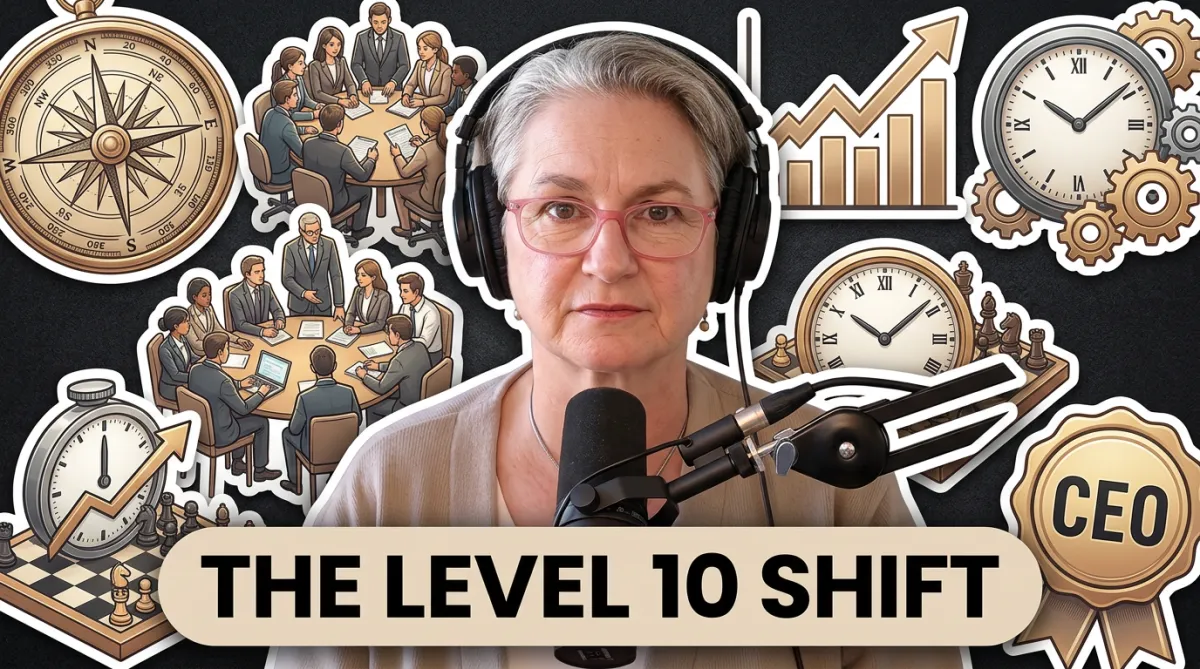
How to Stop Firefighting and Lead as a Strategic CEO
Mastering Business Flow, Episode #25: If I Only Had 5 Minutes With a 'Firefighter' Business Owner, I’d Change This
Listen Now Links:
[Apple Podcasts] | [Spotify] | [YouTube]
Summary Are you an "overpaid employee" trapped in a business that relies entirely on your memory to survive? Many 7-figure owners feel they must be available 24/7 to keep the wheels turning, but this "open-door" culture is actually a bottleneck. We know how exhausting it is to run on pure adrenaline, putting out daily fires just to prevent things from slipping through the cracks.
In this episode, we provide the Answer: The Level 10 Meeting framework. By shifting from reactive texts to a structured weekly pulse, you change your chaotic, invisible workflow into a documented, well-oiled machine. The "Aha!" moment comes when you realize that protecting your focus (and your team's) isn't selfish—it's a financial necessity. This shift allows you to stop being the "Cat-Herder" and start being the "Conductor". The end result? You reclaim 10 hours a week, scale without burnout, and finally achieve "The Double Win"—winning at work and succeeding at life.
Ready to Stop the Adrenaline Management?
If you are tired of being the "human Google search" for your team, it’s time to install a professional pulse in your business. You don't need more Slack notifications; you need a system for solving problems once and for all.
Download my Effective Leadership Meeting Template—the exact 90-minute framework I use to help overwhelmed owners move from Firefighter to Strategic CEO.
This zero-overwhelm template includes:
The Plug-and-Play Agenda to keep your team on track and under 90 minutes.
The IDS Method for getting to the root cause of any business issue.
The Action Item Tracker to ensure every task has one owner and a deadline.
Download Your Free Leadership Meeting Template Here
Exhaustive Timestamps
[00:37] The "Adrenaline Management" trap: Why your team treats you like a Google search.
[01:50] The "Open Door" Fallacy: How accessibility kills your profit margins.
[02:45] The 20-Minute Focus Tax: The science of context switching and "Deep Work."
[04:10] Bids, Proposals, and Bottlenecks: How slow response times cost you real money.
[05:22] The Invisible Workflow: What happens when your business lives in your "brain" vs. a system.
[07:45] Intro to EOS (Entrepreneurial Operating System) and the Level 10 Meeting.
[09:30] The Anatomy of a 90-Minute Pulse: Updates vs. Issues.
[11:15] Root Cause Analysis: Why "band-aid" solutions ensure problems keep popping back up.
[13:05] Defining Ownership: Every action item must have "one and only one" owner.
[15:40] The 90-Minute Calendar Block: Picking your "Tuesday" for business growth.
[17:15] Setting Boundaries: When to tell your team "Save it for the meeting."
Resource Hub
The ONE Thing by Gary Keller (Concept: Simplicity & Action).
Traction / EOS by Gino Wickman (Concept: Level 10 Meetings).
Episode 20: Drowning in your team messages? This $100k communication rule will save you.
Key Takeaways
Leadership ≠ Availability: Training your team to wait for the weekly meeting builds their problem-solving "muscles" and stops you from being the bottleneck.
The Cost of Context Switching: Interruptions aren't just annoying; they are a direct tax on your profitability and "Flow" state.
Single-Point Accountability: Every task must have one owner. If two people are responsible, no one is responsible.
System over Memory: A business that relies on the owner's memory is a "job" you can never leave. Documentation is the key to freedom.
Transcript
The "Open-Door" Profit Leak
If we had five minutes together and you told me you were too busy for a weekly leadership team meeting—or that you don’t need one because you’re "constantly in touch" via text and email—I would tell you that is exactly why your profit is leaking.
You think being available 24/7 is leadership, but actually, it’s adrenaline management. You are training your team to treat you like a Google search. Every time they have a question, they come to you. Instead of taking ownership, they offload every little problem onto your plate. Your "open-door policy" is actually keeping you trapped in a hamster wheel, spinning in circles instead of moving the business forward.
The Real Cost of a "Quick Question"
We often think, "I'll just run by their desk" or "I'll just send a quick text," assuming it’s efficient. It isn’t.
Context Switching: When you interrupt someone, you pull them away from their current task. If they were doing deep mental work—like a customer proposal—it can take over 20 minutes to get back into that state of focus. You are effectively doubling the time it takes to complete tasks.
Losing Flow: Constant interruptions prevent you and your team from entering a "flow state"—that deep concentration where we do our best, most rewarding work.
The Bottom Line: If it takes longer to get bids out, you send fewer bids. Fewer bids mean fewer wins and less money for the business. Every interruption is a tax on your profit margin.
The Danger of the "Invisible Workflow"
When you rely on texts and chats, you create an invisible workflow. There is no central place for information; it’s just scattered across everyone's individual brains, email threads, and text history.
The Search Trap: You waste hours looking for information or, worse, you forget it entirely.
Individual Memory vs. Systems: You aren't running a business on a system; you’re running it on memory.
The Fragility Factor: If a key team member leaves, all that undocumented information leaves with them. Things inevitably slip through the cracks.
The Solution: The EOS Level 10 Meeting Framework
To fix this, you need a regular "Pulse"—a weekly meeting at the same time, every week, with your key players. Here is the basic structure:
The Logistics: A 90-minute block for your leadership team (typically 3–10 people who get stuff done).
The First 25 Minutes (Updates): This is a quick check-in. Was it done or not done? Is there a problem? Do not go off on a ramble. If a new issue arises, you simply add it to the Issues List without discussing it yet.
The Bulk of the Meeting (ID-S): Look at your Issues List and pick the #1 priority.
Identify: Dig down to the root cause so the problem doesn't pop back up.
Discuss: Get feedback from the team. (Note: This isn't a democracy; as CEO, you make the final call, but you want their input.)
Solve: Agree on a solution to try.
The Last 5 Minutes (Wrap Up): Review the Action Item List. Every single item must have one (and only one) owner and a deadline. The owner is responsible for making sure it happens, even if they aren't the one doing the manual labor.
From Firefighter to Strategic CEO
By implementing this, you move from being a Reactive Owner (responding to the day's emergencies) to a Strategic CEO.
Ownership: Your team takes more responsibility because they have a system to report to.
Eliminating Bottlenecks: You stop being the person everyone has to wait on.
Zone of Genius: You and your team can finally work without being pounced on for "quick updates."
How to Start Tomorrow
Schedule the Block: Put a 90-minute recurring meeting on your calendar right now. Tuesdays are great (it allows people to clear the Monday mess first). Start on time, end on time.
Stop the Ping-Pong: Tell your team: "Unless the building is on fire, save it for the meeting." Stop the constant texts. If it’s important, put it on the issues list.
Kill the Email To-Do List: Use a shared agenda for the leadership team. If a task isn't on the action item list with an owner and a deadline, it doesn't exist.
Closing Thought: If you’re working too hard because you’re too accessible, you’re the bottleneck. Stop chasing your team and start installing systems.
Download the Effective Leadership Meeting Template.
A Note on my Process: This episode is 100% my own ideas and reflections, fueled by deep research. I use AI as my "production crew" and research assistant—it helps me organize complex data, generate visuals from my notes, and polish the final video. While I use AI to help synthesize information, I personally fact-check and verify every key data point to ensure accuracy. I use these tools to handle the heavy lifting of production so I can stay focused on sharing high-quality, authentic insights with you.

Unleash Your Business Brilliance.
Create a business that fuels your life.

© 2026 Cordes Lindow LLC - All Rights Reserved