
See Our Latest Blogs
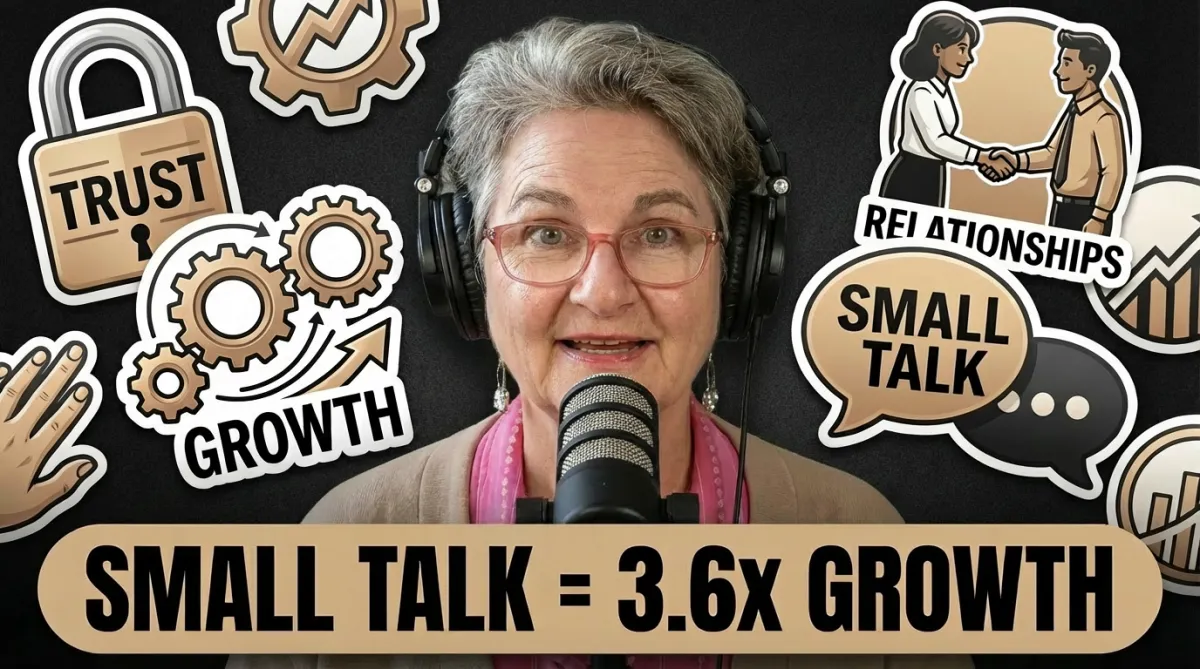
The 3.6 times Revenue Multiplier: Why Small Talk is Your Biggest Strategic Investment
Mastering Business Flow, Episode #42: The Efficiency Paradox
[Apple Podcasts] | [Spotify] | [YouTube]
Summary
You’ve likely felt the pressure to cut every second of "fluff" from your day just to keep your head above water. You skip the "How was your weekend?" and dive straight into project tasks because your business relies entirely on your memory and constant presence to survive. We know how exhausting it is to run on pure adrenaline, treating every interaction as a transaction just to keep the wheels turning.
But here is the "Aha!" moment: by skipping the small talk, you aren't being efficient—you’re actually paying a "trust tax" that slows your business to a crawl. Investing in "casual" connection is the answer to installing an Operational Focus System that builds a documented, well-oiled machine driven by your team. When you master this, you reclaim 10 hours a week and achieve the Double Win.
Timestamps
[02:15] The Efficiency Paradox: Why cutting "fluff" actually creates friction.
[04:45] The Science of Psychological Safety: How small talk builds the foundation for Maslow’s hierarchy in the workplace.
[08:10] The 42% Knowledge Gap: Tapping into the "Invisible Workflow" stored in your team's heads.
[12:30] Hidden Potential: Using curiosity to find the "3D printers" in your organization.
[18:20] The 5-Minute Rule: Practical steps to architect "Casual Collisions" in a virtual world.
Key Takeaways
Small Talk as a Decoding Tool: Without personal rapport, team members spend excessive "cognitive load" trying to decode the tone of short, abrupt digital messages.
The 21% Profitability Boost: High-trust teams are significantly more profitable because they feel safe enough to experiment, point out system flaws, and innovate without fear.
Knowledge Mining: 42% of company institutional knowledge exists only in casual conversation; if you don't talk, you don't know your own business.
Retention is Revenue: It costs twice as much to replace an employee as it does to keep one; small talk is the cheapest insurance policy against burnout.
Why It Matters: The Neuroscience of Trust
As a professional educator, I look at business through the lens of how adults actually learn and change. Our brains are hardwired for survival. According to Maslow’s Hierarchy of Needs, if an employee doesn't feel a baseline of safety and belonging, they cannot access the higher-level functions of their brain—the parts responsible for problem-solving and creativity.
When we engage in small talk, we aren't wasting time. We are signaling to the lizard brain of our team and customers: "You are safe here. I see you as a human." This creates Psychological Safety. Without it, your team won't take risks or tell you when a system is breaking. They become reactive robots waiting for instructions rather than the initiators you need them to be.
Practical Application: From Operator to Architect
To move toward Flow, you don't need to spend hours at the water cooler. You need a system for connection to encourage small talk.
The 5-Minute Check-in: Start every meeting with a personal win or a headline. This acknowledges the humans in the room before the tasks on the screen.
Avoid "The Best/Favorite" Trap: Don't ask "What is your favorite book?" It creates high cognitive load. Ask "What is a book you’ve read lately?" to keep the conversation low-friction.
The "Tell Me More" Lever: When an employee shares a hobby or a thought, use these three words and wait 5 seconds. This is where the "Hidden Talents" are discovered.
Orchestrate Casual Collisions: If you are virtual, schedule drop-in times or send a non-work-related text once a week to maintain the "Social Glue."
The One Thing to do this week:
In your very next meeting, spend the first five minutes asking one low-stakes question (e.g., "What's a restaurant you'd recommend?") and listen 60% of the time.
Resources Mentioned
The Advantage by Patrick Lencioni
Ready to find your invisible workflow? Book your Operational Diagnostic Call here.
A Note on my Process: This episode is 100% my own ideas and reflections, fueled by deep research. I use AI as my "production crew" and research assistant—it helps me organize complex data, generate visual slides from my notes, and polish the final video. While I use AI to help synthesize information, I personally fact-check and verify every key data point to ensure accuracy. I use these tools to handle the heavy lifting of production so I can stay focused on sharing high-quality, authentic insights with you.

Unleash Your Business Brilliance.
Create a business that fuels your life.

© 2026 Cordes Lindow LLC - All Rights Reserved