
See Our Latest Blogs
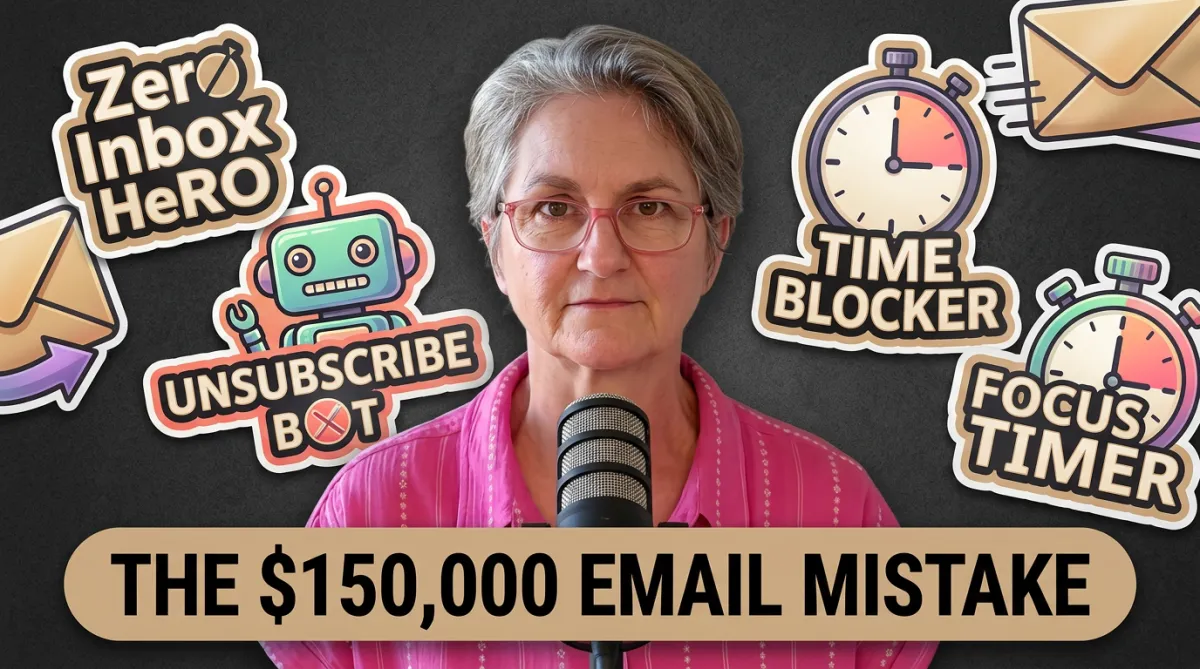
The Truth About Quick Replies: Why Your Inbox is Killing Your Profit
Mastering Business Flow, Episode #19
Listen Now
[Apple Podcasts] | [Spotify] | [YouTube]
The Cost of "Quick" Replies We don't realize how much time we're spending in email or how much that time is costing us. Every notification triggers a context-switching tax. Your brain switches from high-value tasks to reactive responding, stripping away the value you add as a CEO.
In this episode, we dismantle the "invisible workflow" of email that traps busy owners on a hamster wheel of counterproductive productivity. By shifting from a reactive "Firefighter" to an intentional "Conductor," you can turn your chaotic inbox into a documented, well-oiled machine driven by systems, not your stress.
Featured Resource: The Strategic Growth Course
Ready to step out of the daily weeds? Sign up for our Strategic Growth Email Course. It is a zero-overwhelm program delivered one actionable step at a time via email. No fluff, just the systems you need to move from Operator to Owner.
Join the Free Course at cordeslindow.com/business-growth
Timestamps
[00:00] The hidden cost of notifications and the "Context Switching Tax."
[01:30] Cordes’ journey: From federal government "inbox living" to checking email twice a week.
[03:45] Why email is an "External To-Do List" that gives others permission to dictate your day.
[05:20] The Designer's Dilemma: How email delays cost one company their winning bids.
[06:40] Data Loss: Why we lose 2 hours a day simply searching for information.
[08:15] Applying Parkinson’s Law: Why limiting your time makes you more effective.
[10:30] The 80/20 Rule of Email: Unsubscribing for the sake of your brain (and their deliverability).
[13:00] Gmail Task Integration: Moving requests from the inbox to the calendar.
[15:10] Internal vs. External Communication: Why your team should stop emailing you immediately.
[17:40] The Auto-Responder Strategy: How to set boundaries without losing clients.
[21:00] Text Blaze & Snippets: Using templates to stop repeating yourself.
[23:30] The "Nuclear Option": Archiving everything older than 30 days.
Resource Hub
Tools: ClickUp (Project Management), JobTread (Dashboard/Workflow), Text Blaze (Snippets).
Concepts: Parkinson’s Law, The Pareto Principle (80/20 Rule), The "Double Win."
Books Mentioned: The ONE Thing by Gary Keller, Full Focus by Michael Hyatt.
Key Takeaways
Kill the Notifications: Every interruption costs up to 23 minutes of "recovery time" to reach deep focus again.
Time-Box Your Presence: Start with three 30-minute windows; work toward checking once per day.
Contextual Communication: Keep internal conversations inside project management tools (like ClickUp) or documents, not buried in chronological email threads.
The 30-Day Rule: If you haven't replied in a month, the urgency has passed. Archive it and move on.
Be Proactive: Use an auto-responder to tell people when you check email, setting the expectation for your 24-hour response time.
From Living in my inbox to Twice-a-Week Email: My Story
My journey with email started in the 90s in a corporate federal government job. Back then, my entire workday was defined by the inbox. I’d walk in, sit down, open the computer, and the email list became my to-do list for the day. I was living in a reactive state, hoping to "get to my real work" by the end of the day.
Two decades later, while teaching in public schools, the stakes changed. I had six hours of face-to-face time with students and a requirement to respond to emails within 24 hours. I couldn't be a responder anymore. I had to develop a system of clearing emails in 15-minute bursts so I could focus on what actually mattered: planning and teaching.
Today, as a business owner, I’ve taken it to the extreme. I check my email roughly twice a week, usually while waiting for my children at their sports activities. I’ve moved from being reactive to my inbox to proactive with my time.
3 Reasons Why Your Inbox is Killing Your Profit
1. The "Context Switching Tax" Every time a notification pings and you look at it, you aren't just losing 30 seconds. Statistics show it can take up to 23 minutes to regain deep focus after a distraction. If you’re getting notifications every 11 minutes, you are effectively never operating at your full cognitive capacity.
2. The $150,000 Financial Drain The average CEO spends four hours a day in their email. If you value your time at a modest $150/hour, that is $150,000 per year spent on an "External To-Do List." This is a list created by other people’s demands, not your strategic vision.
3. The Search Trap Email is organized chronologically, not topically. We lose an estimated two hours a day (a full day per week!) just searching for information buried in threads, texts, and various folders.
The Operational Focus System: Tips to Reclaim Your Time
Set your timer: According to Parkinson’s Law asks expand to fill the time allotted to them. Stop leaving your inbox open all day. Set a timer for 20 or 30 minutes. The pressure of the clock will force you to make decisions faster.
The "Unsubscribe" Habit: 80% of your volume comes from 20% of your least important contacts. Ruthlessly unsubscribe from newsletters you don't read. It’s better for your focus and better for their email deliverability.
Inbox Zero-ish: You don't need a clean slate; you need a relevant slate. Aim for under 20 messages which are all current action items. Do this when you get in your inbox:
Reply or act on any email you can do in less than 2 minutes.
Delete/Archive emails you don’t need (archive is searchable, so don't be afraid to use it).
The "Snooze" & Task Feature: If you can’t deal with it now, snooze it or turn it into a Google Task with a specific date and time on your calendar.
Remove Internal Communication: Move your team out of your inbox. Use comments in Google Docs or project management tools like ClickUp. Keep the conversation where the work is happening.
Forget Folders: Searching is faster than sorting. Use keywords, date ranges, and attachment filters instead of maintaining a complex folder tree.
Auto-responder: 50% of people feel they must respond within an hour, but only 15% of senders actually expect it. Break the "Quick Reply" addiction by adding an auto-responder which changes the expectation of a reply for the sender.
Use Snippets & Templates: Don't type the same answer twice. Use tools like Text Blaze to store blocks of text for common inquiries.
The Takeaway Action Item: The Nuclear Option
If you are drowning in a "Cat-Herder" level of chaos right now, do this today: Archive everything older than 30 days. You aren't deleting them; they are still searchable. But if you haven't responded in a month, the urgency has passed. If it’s truly important, they will follow up. Once you've cleared the deck, turn off all notifications on your phone and computer. Set your first "Time Box" for tomorrow morning and start leading your business instead of defending your inbox.
Quick Win: Go to your settings right now and turn off all desktop and mobile email notifications. In today’s episode, we talked about how notifications steal your "Strategic Growth Time"—but silencing the pings is just one piece of the puzzle. To install a full "Operational Focus System" so your team drives the business while you stay in Flow, sign up for the Business Growth course here.
A Note on my Process: This episode is 100% my own ideas and reflections, fueled by deep research. I use AI as my "production crew" and research assistant—it helps me organize complex data, generate visual slides from my notes, and polish the final video. While I use AI to help synthesize information, I personally fact-check and verify every key data point to ensure accuracy. I use these tools to handle the heavy lifting of production so I can stay focused on sharing high-quality, authentic insights with you.

Unleash Your Business Brilliance.
Create a business that fuels your life.

© 2026 Cordes Lindow LLC - All Rights Reserved