See Our Latest Blogs
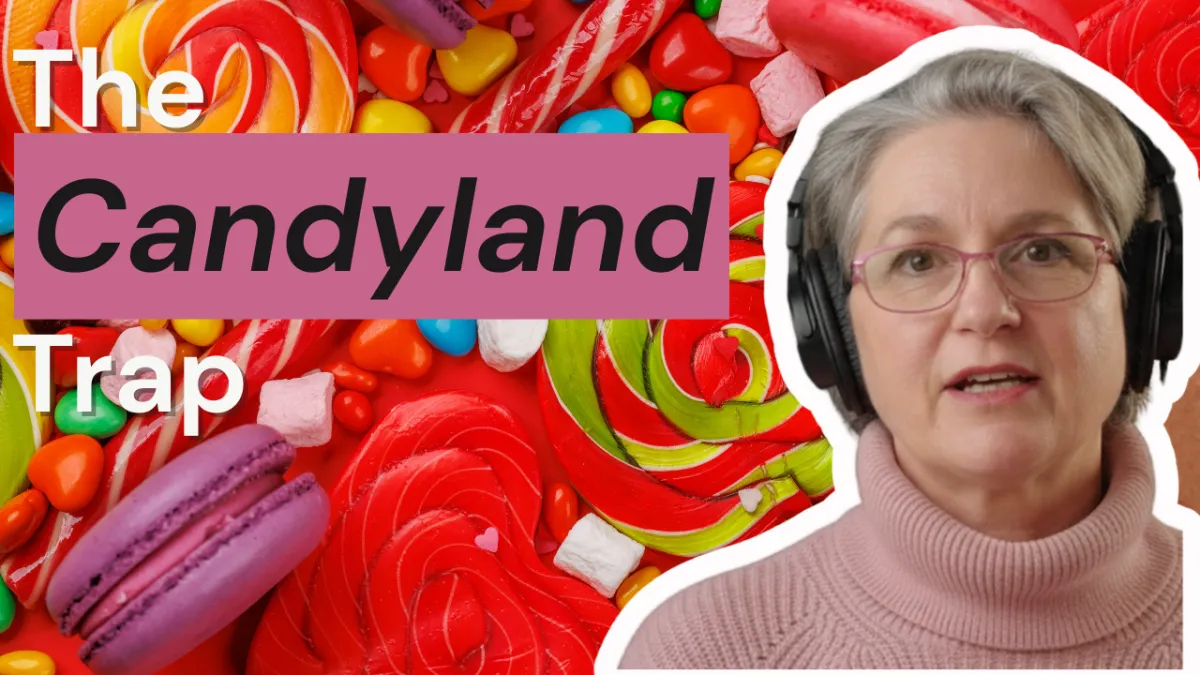
The Candyland Trap: How Shiny Object Syndrome Kills Business Growth
The Candyland Trap: Why “Good Ideas” Are Killing Your Business Growth
Mastering Business Flow, Episode 5
Before you start a new project, it feels limitless. In your mind, you have a vision of how perfect it’s going to be. But the moment you get started, it's not perfect anymore. It gets messy. It gets limited. It becomes real.
In the world of small business, we don't usually have an idea shortage; we have a filtering problem. We are spread so thin across a dozen "good" ideas that we never make progress on the one "great" one. To find your optimal state of performance—your business flow—you must learn the discipline of the straight path.
The Ancient Wisdom of the Straight Path
Every new book, course, or software sparks a fresh wave of ideas. We tell ourselves these are "magical solutions" that will 10x our revenue. However, there is a reason ancient wisdom warns us to:
"Look straight ahead and keep your eyes on what lies before you. Mark out a straight path for your feet." — Proverbs 4:24-27
As a business owner, your greatest asset isn't your creativity—it's your direction. If you aren't looking straight ahead, you are meandering side-to-side, wasting energy on "good" distractions while the "great" work remains untouched.
3 Reasons we struggle to stick with one thing and become great in our businesses
(and how doing the one thing helps us become great and feel better)
Reason one: all the shiny objects and “Good” things for our business
The Problem: In today’s world, the "straight path" is crowded with "good ideas" that act as dangerous distractions keeping you from achieving great things. Instead of putting all of your energy into what will really make a difference for your business, you are busy chasing each new shiny object thinking it is a magical solution.
I wanted to improve my running performance. My trainer said I need to increase my running cadence and keep my heart rate in zone 2. Trying to do both at once made me feel like a failure, because I would work on one, and it would through the other out of balance. It left me stressed and not succeeding at either. I gave up tracking my cadence and focused only on the heart rate, then running became easier and I stayed in my zone longer. By focusing on one thing, I actually became a better runner. If you track ten metrics, you’ll master none.
As Jim Collins reports in Good to Great, businesses fail most often because of chasing too many “good” ideas. Our minds think the shiny object will be a better solution than what we are doing, or we hear about another good idea, and it could be a ‘good’ business activity, but the mere fact of trying to do it all weakens your focus and attention on the one thing that will really empower your business to become great, because each additional project or initiative is sucking away our energy in the background.
The Reality: In business, we rarely fail because of "bad" ideas. We fail because we have too many "good" ones. We think our business is a straight path like in the Proverbs verse, but in reality our business journey often mimics the board game Candyland. We think we’re moving toward the goal, but we keep drawing cards that pull us into "side-quests" that feel like progress but are actually traps:
The Peppermint Forest (The Tool Trap): You spend weeks migrating data to a new CRM or project management tool instead of doing the work. You’re still at the beginning of the game; you’ve made zero progress.
The Gumdrop Mountains (The "Hack" Trap): You consume $27 PDF templates and "quick-win" hacks. They provide a sugar rush of excitement but zero nutritional value for scaling a real business.
The Licorice Forest (The Comparison Trap): You see a competitor launch a new Reel style or offer. You stop your "One Thing" to copy them, and you lose your turn.
The Peanut Acres (The Motion Trap): Professional development overload. You sign up for masterminds and certifications that aren't aligned with your immediate goals. It feels like work, but it’s just motion rather than action.
The Molasses Swamp (The Perfectionism Trap): You try to get every detail perfect before launching. You think you’re being thorough, but you’re just stuck in the mud.
Solution One: Put all your energy in one thing, not all the things
The Distraction: A "good" idea is the most dangerous distraction because it feels productive. If you spend 10% of your energy on ten "good" ideas, you’re left with a "good" business that never becomes Great. Focus your 100% intensity on the one "Great" move for the quarter. Keep your eyes on the one thing - keep your path straight and don’t fall for the Lollipop Woods and Molasses Swamp - they may be yummy, but it will take longer to get to the Candy Castle!
Reason Two: Reality is Messier than the Shiny Object in the window
The Problem: We start new projects because they appear free from the messiness that made us quit the last one. Once we get started on projects, it gets hard and messy, and we assume we aren’t doing it right, so we don’t finish and instead seek a new shiny object.
For a practical example, when I was a kid, Barbie commercials showed cars driving through magical forests, and I thought about how amazing that was and I wanted to have that same experience. But when I my Barbies in their car at my house, I was just pushing it on my carpet. It felt lackluster.
This is Construal Level Theory: When we see a project from afar (a new idea), it looks magical and easy. Once we get inside the project (the one we are currently working on), we see the messy details. We abandon our current path for a new one not because the new one is better, but because we haven't seen its messiness yet. Every project is messy in the middle.
This desire for the perfect solution is what causes us to keep chasing shiny objects. We have difficulty sticking with “the one thing” because when we get into the work to do the thing, it is hard and messy so we assume we are doing it wrong and get distracted by what appears perfect from the outside.
Solution two: Satisfice for the ‘good enough’, one thing, solution.
Recognize that there is no perfect solution. They all have problems once you get in them, and that is part of the process. The only way to truly become great is to keep putting in the reps with your one thing - your one idea, one product, one solution, one customer and focus on becoming the greatest you can at that. Switch from a "Maximizer" mindset to a "Satisficer" mindset.
Satisficing means identifying your key criteria and choosing the solution that meets 80% of them.
Stop wondering if there is a better solution out there. Even if there is, the time and energy you waste looking for it is more expensive than the "perfect" tool would ever be.
Reason 3: Unfinished business drains our energy for the important work
The Problem: Every shiny object we chase becomes another to do list and leads to more unfinished projects. Every unfinished project drains our energy.
It’s like a smartphone with 50 apps open in the background. Even if you aren't using them, they are draining your battery. Every half-written email, every "maybe" project, and every unfiled paper is a background program draining the energy you need for the work that actually moves the needle.
We think the 'big' things are what's draining us, but it’s actually the 'thousand tiny cuts' of unfinished business.
Psychologists call these unfinished projects and to-do lists an Open Loop. The Zeigarnik Effect explains that our brains are hardwired to "ping" us with notifications about everything we haven't finished. That means the more unfinished business we have, the more resources our brain is keeping in the background. Our brain wants to be able to ‘notify’ us and remind us of what is still ‘undone’, this means we have less energy to do the work we need to do.
Solution three: Get something done for your one thing.
Finishing something—anything—creates an immediate surge of energy. When you close a loop, your brain releases dopamine and clears the "RAM."
Instead of looking for the next magic wand, let’s put all of our resources into one thing so that we can make an impact. As we put our energy into one priority area, we are able to finish more. In the finishing and closing of projects, we gain energy to accomplish more.
How to get started on one thing?
Imagine how it would feel to put your energy into just one thing over the next quarter.
What impact would it have to be able to spend focused energy on something that really mattered for your business?
How could that impact your bottom line?
How would that impact your stress levels?
Try the following steps:
Pick One Thing: Ask yourself: What’s the ONE Thing you can do in the next 90 days that would make everything else would be easier or unnecessary?
Decide your next step.: Break the "One Thing" into a next step you can finish in one sitting. Don’t make an impossible list, just write down the next action that you will take either today or tomorrow and block time on your calendar to do it.
Create a Done List: Start a list of tasks you have completed for your one thing. Crossing them off sends a signal to your brain that you are a finisher.
Ready to Stop Zigzagging?
Free Email Course: Get one focus-driven tip each week to grow your business one step at a time at www.cordeslindow.com/business-growth.
Listen to the entire podcast
[00:00] – The Illusion of the New Project: Why ideas feel limitless at the start but messy in the middle.
[04:15] – The Straight Path vs. The Zigzag: Lessons from Proverbs on marking a straight path for your feet.
[07:30] – The Candyland Trap: A breakdown of the "distraction map":
The Peppermint Forest: Shiny new tools and software.
The Gumdrop Mountains: The cycle of $27 "quick-fix" courses.
The Licorice Forest: The trap of competitor comparison.
The Molasses Swamp: Paralyzing perfectionism.
[12:45] – Running and Focus: How tracking too many metrics (cadence, heart rate, pace) leads to failure, and why picking one leads to success.
[15:20] – The "Invisible Energy Vampires": Understanding the Zeigarnik Effect and how open loops in your brain drain your daily energy.
[19:10] – Maximizers vs. Satisficers: Why "good enough" is actually the secret to finishing.
[23:00] – Action Plan: How to choose your "One Thing" for the next 90 days and build a "Done List."

Unleash Your Business Brilliance.
Create a business that fuels your life.

© 2026 Cordes Lindow LLC - All Rights Reserved