
See Our Latest Blogs
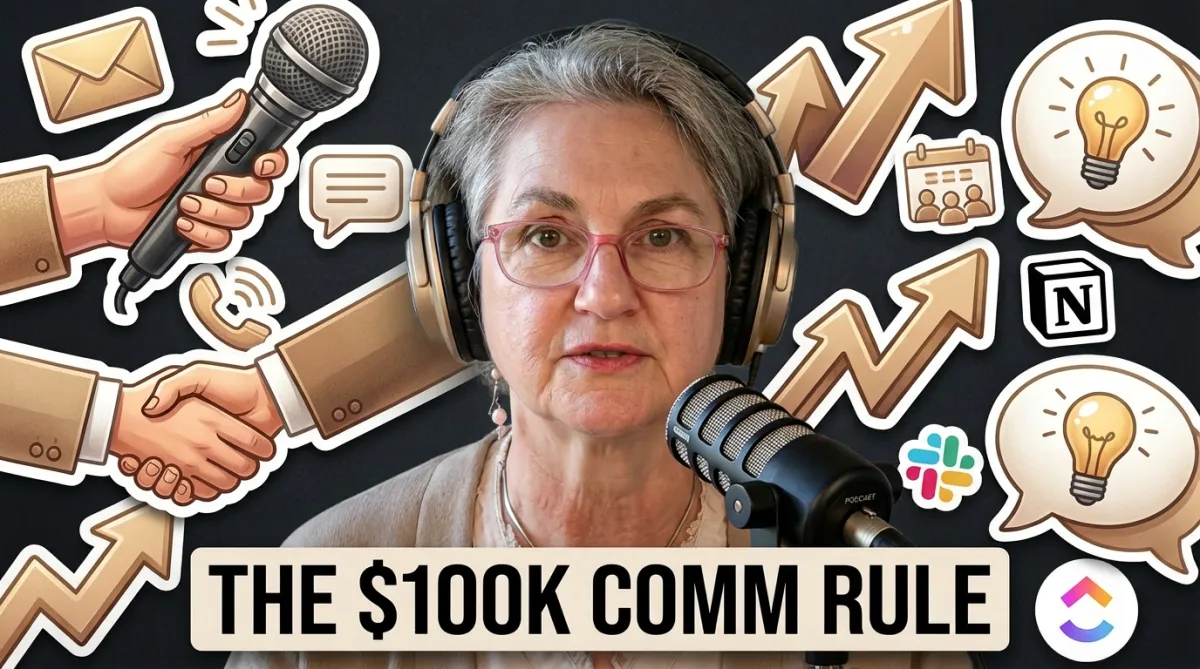
Stop The $100k Scavenger Hunt: Internal Communication Rules
Mastering Business Flow, Episode #20: Drowning in your team messages? This $100k communication rule will save you.
Listen Now: [Apple Podcasts] | [Spotify] | [YouTube]
The Transformation
Are you exhausted from sorting through endless text chains and email threads just to find one piece of data? You aren't alone—the average professional spends two hours a day just looking for information they already have. We know how draining it is to run on pure adrenaline, putting out fires because your business relies on your memory rather than a system.
In this episode, we break down why "convenient" messaging is actually a "tax" on your profit and how to replace the chaos with a streamlined workflow. By categorizing your tools into the River, the Reservoir, and the Library, you can turn an invisible, individual-dependent workflow into a documented machine. It's time to stop acting like an overpaid employee trapped on a hamster wheel and start operating as the Architect of your business. Discover how to reclaim 10 hours a week and finally achieve the Double Win—winning at work and succeeding at life.
The CTA: Zero-Overwhelm Business Optimization
Stop the "Firefighter" cycle today. Join the Strategic Growth Email Course. This is a no-cost, step-by-step program delivered one strategic item at a time to ensure zero-overwhelm.
The Quick Win: This week, audit your last 10 internal messages. If they were sent via text or email, they are likely lost in "The River." The course will show you exactly how to migrate those to a "Reservoir" tool like ClickUp or Asana so they never go missing again.
Key Takeaways: The 4 Levers for Growth
Kill the "Convenience" Habit: Sending a text is easy for the sender but creates a "scavenger hunt" for the receiver.
Categorize by Shelf-Life: Use The River (Chat) for fleeting talk, The Reservoir (Tasks) for action items, and The Library (Wiki) for permanent standards.
Centralize Context: Always keep discussions about a specific task inside that task to avoid the "Where did we talk about this?" fatigue.
Install a Leadership Pulse: Use Level 10 meetings to move from individual-dependent to team-driven operations.
Exhaustive Timestamps
[00:00] The exhaustion of the "information hunt."
[01:45] The "Scavenger Hunt" Tax: Breaking down the $25,000-per-employee annual cost.
[03:50] Introduction to Nick Sonnenberg’s Come Up for Air philosophy.
[04:40] The Rule: Communicating where the work lives vs. where you are.
[06:30] The River: Using Slack and Google Chat for high-speed, low-shelf-life info.
[08:15] Why you should keep Slack channels private and use naming conventions.
[10:10] The Reservoir: Managing actions in Asana, ClickUp, or Monday.com.
[11:45] The Power of Context: Why comments belong in the document, not the chat.
[13:00] The Library: Creating a searchable Wiki for SOPs and brand assets.
[16:00] Tool Recommendations: Why ClickUp is the "all-in-one" winner for small businesses.
[18:30] Synchronous vs. Asynchronous: When to actually pick up the phone.
[20:10] The Level 10 Meeting: Borrowing from EOS to solve issues permanently.
[22:00] Your 2-Step Implementation Plan: Deciding tools and creating "One-Pagers."
The Full Transcript Breakdown
A Note on my Process: This episode is 100% my own ideas and reflections, fueled by deep research. I use AI as my "production crew" and research assistant—it helps me organize complex data, generate visual slides from my notes, and polish the final video. While I use AI to help synthesize information, I personally fact-check and verify every key data point to ensure accuracy. I use these tools to handle the heavy lifting of production so I can stay focused on sharing high-quality, authentic insights with you.
The $100,000 "Scavenger Hunt"
If you have an employee that costs you $50 an hour and they’re wasting two hours a day looking for information, that’s $25,000 per year, per employee. For a team of four, that’s $100,000. If you have a team of 20, that costs you $500,000. This is what I call the Scavenger Hunt. Most people send messages based on what is convenient for them at the moment—usually a text or an email—but that is rarely where you need the information in the future.
The Golden Rule of Communication
To end the scavenger hunt, you must follow one rule:
Put the communication where the work lives, not where you are currently sitting.
Take the extra second to think about where you will be looking for this info in three months.
The Three Buckets: River, Reservoir, and Library
1. The River (Flowing Conversations)
Think of this as high-speed information with a short shelf-life. This is where your internal team chat lives (Slack or Google Chat).
The Goal: Get internal team members out of email and text. (see episode 119: The truth about quick replies: Why your inbox is killing your profit)
Best Practice: Use private channels for specific projects or teams to avoid "message bloat." Assign a channel owner who monitors the members and the content. When the project is over, archive the channel. The River is for discussing work, not storing it. Use private channels to ensure you have all the right members, and ONLY the people who need to know.
2. The Reservoir (Tasks and Actions)
This is where you track projects, tasks, and deadlines using tools like Asana, ClickUp, or Monday.com.
The Goal: Keep the comments on the task itself.
Best Practice: If you’re working in a document or a task, you shouldn't have to switch apps to see the status. This eliminates the "Did you do this yet?" messages because the status is visible to everyone. Make sure team members update statuses at least once per week so no one needs to send out more communication to find out. Every task should have an owner (and only ONE) and a deadline.
3. The Library (Static Standards)
This is your company Wiki—things like SOPs, brand assets, logos, and company decisions.
The Goal: Create a searchable, permanent home for info that doesn't change often.
Best Practice: Use Notion or Google Drive to ensure that when a new person joins the team, they have everything they need at their fingertips without asking you.
Choosing the Right Tools
For a small business, I highly recommend ClickUp. While big corporations might pay for Slack, Asana, and Notion separately, ClickUp allows you to have your chat (River), your tasks (Reservoir), and your docs (Library) all in one place. This saves money and reduces "app fatigue." You don’t need to spend a lot of money getting all the fancy tools. The key is to get everyone on the same page using the same apps for the same purposes. If all you have is Google Workspace, you can still apply these same principles using their chat, document comments and tasks.
When to Actually Meet
Most small businesses don't have enough of the right meetings. Use Asynchronous communication (chat/tasks) by default. Move to Synchronous (meetings/calls) for sensitive topics or complex brainstorming. I highly recommend regular leadership meetings using the Level 10 Meeting agenda from EOS to help your team solve issues without you having to be the firefighter.
Your 2-Step Action Plan
Decide on your tools: Pick one for chat, one for tasks, and one for your library.
Create a "One-Pager": Make a visual guide for your employees so they know exactly which tool to use for which scenario. Drill these habits until they become your company culture.
Resource Hub
The Blueprint: Traction: Get a Grip on Your Business by Gino Wickman (The EOS Level 10 Meeting).
The Tool for Small Business: ClickUp – The recommended "all-in-one" for the River, Reservoir, and Library.
Specialized Tools: Slack (River), Asana (Reservoir), Notion (Library).
Deep Dive: Episode 19 – Why Email is Killing Your Productivity.

Unleash Your Business Brilliance.
Create a business that fuels your life.

© 2026 Cordes Lindow LLC - All Rights Reserved